
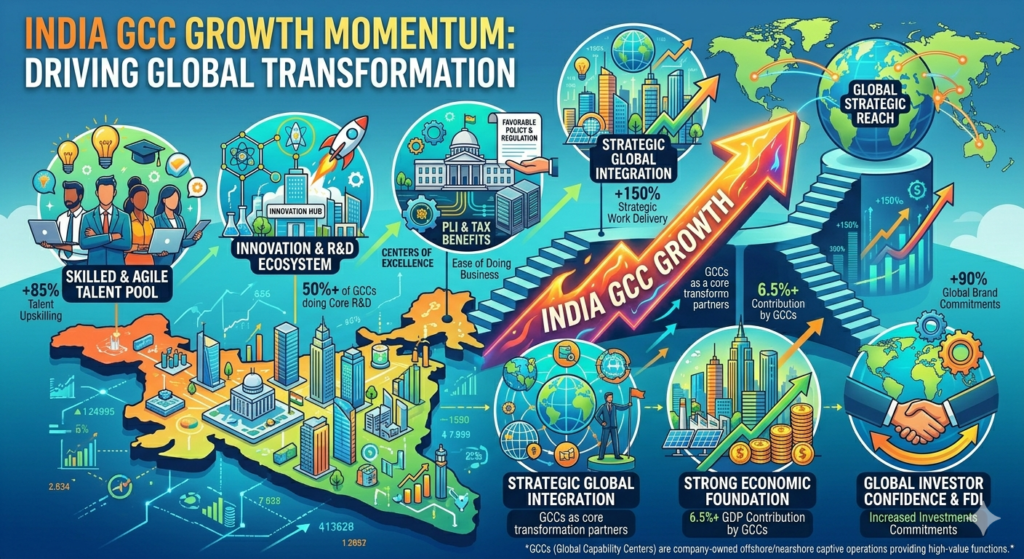
In GCC what has changed?
GCCs are being discussed like they are some new discovery. They are not. We have seen this before, same avatar, different names — captives, GDCs, offshore centers, shared services. Different labels, same basic idea. And for a while, many companies decided the model was not working for them. They outsourced development and back-office work to service providers, while some later brought parts of it back in-house. Now the pendulum is swinging back.
So what changed? My simple take is this: the model itself did not suddenly become great. What changed is the world around it. The kind of work changed. What companies want to control changed. And India’s talent base also changed.
Why is India’s GCCs market growing hotter by the day ? Why is the boom happening now?
First, this is no longer just about saving money.
The newer GCCs are being built for purpose – product engineering, platforms, data, AI, cybersecurity, finance transformation, and core R&D. That is a completely different conversation from the old “cheap back office” story.
Second, India now has scale with experience. Not just a lot of engineers. A lot of people who, over the last 2 decades or more, have actually built products, run platforms, managed risk, and led global work.
Third, companies want more control over what really matters. Product knowledge. Architecture. Data. IP. Risk. After years of disruption, many leadership teams are less comfortable outsourcing the core of the business to 3rd party vendors
And then there is AI. This wave is pushing companies to decide what they really want to own. A lot of them are deciding they want that capability closer to home, even if it sits in India.
What changed compared with the older captive/GDC model?
To me, the shift is simple: earlier versions of this model were built to execute work. This version is being built to own outcomes.
| Strategic Pillar | The Captive / GDC Era (Legacy) | The GCC Wave (Current) |
| Primary Goal | Cost arbitrage and operational savings. | Capability, speed, resilience, and innovation. |
| Work Mix | Support, maintenance, and back-office operations. | Product, platform, data, AI, cyber, and R&D. |
| Core Metrics | Operational metrics: utilization, cost, and throughput. | Value metrics: business impact, ownership, time-to-market, and customer value. |
| Leadership | “Remote control” management directly from HQ. | Stronger local leadership, global mandates, and deep exposure to markets/business context. |
| Relationship | Outsource by default to cut overhead. | Keep core work in-house, partner selectively, and avoid treating the center as an order-taking arm. |
| Location | Mostly Tier-1 cities chosen strictly for cost advantage. | Ecosystem-driven play, including expansion into Tier-2 hubs. |
Also, this is not some dramatic death of outsourcing. That is not what is happening. What is happening is more practical. Companies are getting clearer about what they should own themselves and where they should still use partners.
Will it sustain?
Will it sustain? I think yes, but not automatically. This will sustain only if GCCs keep moving up the value chain. If they become cheaper execution factories again, the story will weaken.
There are real risks: wage inflation, expensive niche skills, concentration in a few cities, and constant competition for talent. So the model is durable, but only if companies invest properly in leadership, culture, and capability building.
| If this happens… | …then GCC growth sustains |
| Centers get end-to-end ownership, not just tasks | They become strategic and harder to unwind |
| Talent is built, not just bought | Attrition and cost pressure become more manageable |
| Tier-2 and Tier-3 expansion is done sensibly | Companies widen the talent base and reduce concentration risk |
| AI, cyber, data, and product work deepen | India stays central to enterprise transformation |
| HQ gives market exposure, context, and inclusion | The center becomes strategic, not transactional |
And this part matters a lot: if headquarters treats the GCC like an order-taking arm, it will behave like one. If it gets market exposure, customer context, and room to think, it will add far more value.
Another reason this may last longer is the spread beyond the usual metros. Bengaluru and Hyderabad will stay dominant, but the expansion into places like Coimbatore, Kochi, Jaipur, and Bhubaneswar makes the story stronger.
Hard truths we should not ignore
But I also think we need to say the harder part clearly.
The opportunity is definitely real. But so are the cracks. And if we gloss over them, this whole GCC story will become more hype than substance.
For example, India has been very good at services and execution for years. Innovation is improving, yes, but let us not pretend it is evenly strong everywhere. Innovation is driven by a deep understanding of customer needs – both expressed and latent, an understanding of gaps in the solutions and inherent curiosity about the business. Indian engineers rarely have access to any of these and naturally the curiosity dies a well. But access is only half the battle. The environment itself must change to facilitate an innovative mindset. If the workplace culture doesn’t support creative experimentation, true innovation simply cannot take root.
Also, having a lot of people is not the same as having enough strong managers, architects, product people, Engineers and subject matter experts. Quantity is there. Quality is still uneven.
Then there is attrition, consistency and commitment. These issues do not disappear just because demand is strong.
There is also the less glamorous side: governance, statutory discipline, data controls, process maturity, and the ability to meet compliance expectations from global companies. That matters even more as GCCs move into higher-value work.
And one more hard truth: sometimes the issue is not India alone. It is organizational behavior. Senior executives may say they want the GCC to succeed but is not backed by adequate organizations measures. At the delivery levels, Managers want visibility, control and speed driven by proximity. Issues that need to be address by systems, tools and processes. More often than not, these are issues that are overlooked, effectively disincentivising Managers from investing into the GCC.
Then there are ideological differences where managers prefer to work with local talent and not external talent. They sometimes indulge in actions that drives mistrust, communication break down and blame games. Situations like these create friction and are self-defeating in nature.
How do we make sure that does not happen?
This is where many GCCs quietly win or lose.
In my view, GCC success cannot be left to goodwill. It has to be designed into the operating model.
First, incentives have to align across HQ and the GCC. If managers lose influence when the GCC grows, they will resist it. If their goals and scorecards reward GCC success, behavior changes.
Second, the GCC needs explicit ownership. Not vague support roles. Not endless execution. Real ownership. What product, process, or platform does it own? What decisions can it make? What outcomes is it accountable for?
Third, leadership matters on both sides. You need strong India leaders, strong HQ sponsors, and a few bridge leaders who understand both the business context and the India context. Without that, mistrust fills the gap.
Fourth, give teams exposure to markets, customers, and business decisions early. If they never see the customer, never hear the commercial discussion, and never understand the market, they will behave like service teams. People cannot add value in a vacuum.
Fifth, build a quality bar, not just a hiring engine. Scaling headcount fast and lowering the bar is one of the quickest ways to lose trust.
Sixth, attack attrition structurally. Better managers. Better role design. Better career paths. Better work. If people feel they are only there to execute instructions, attrition will continue.
Seventh, governance has to be built early, not patched later. Decision rights, documentation, risk controls, statutory discipline, and transparent metrics all matter if the center is going to own serious work.
Where HQ should invest if it wants GCCs to become strategic?
This is the other side of the story. If headquarters wants the GCC to become strategic, it cannot invest only in office setup, hiring plans, and leadership speeches. It has to invest in the conditions that make strategy possible. Involve In GCC Leadership team in Strategic Conversation. CEO and executive sponsors need to champion the GCC’s value proposition, ensuring every layer of the organization understands its impact, not just on the bottom line, but on driving tangible and intangible success for all stakeholders.
First, invest in real ownership, not just work allocation. A GCC does not become strategic because it gets more work. It becomes strategic when it gets empowerment, end-to-end ownership, decision rights, and accountability for outcomes.
Second, invest in market and customer exposure. If teams in India do not understand customers, product priorities, commercial realities, and regulatory context, they can execute — but they will struggle to add higher-order value. If you want judgment, you have to give context.
Third, invest in strong bridge leadership. Not every good HQ leader knows how to build a successful GCC relationship. Not every good India leader can automatically navigate global politics and enterprise expectations. You need leaders on both sides who know how to build trust across geographies.
Fourth, invest in manager alignment and incentives. Executive support is not enough if middle management is misaligned. Managers should be measured on whether they integrate the GCC well, give meaningful ownership, share context, emotionally connect with the team and help build capability in the center.
Fifth, invest in capability building, not just hiring. Hiring strong people is only the start. If the GCC is expected to own more complex work, headquarters has to invest in manager development, product capability, domain depth, architecture thinking, quality practices, and mentoring from global experts.
Sixth, invest in trust-building mechanisms. Trust should not depend only on personal chemistry. It should be built through clear decision rights, transparent metrics, shared goals, common governance, and direct communication channels.
Seventh, invest in culture and inclusion. A GCC cannot become strategic if it is still treated as the offshore team. It has to be included in important discussions, heard in planning forums, and given room to challenge, not just room to execute.
And finally, invest with patience. A GCC does not become strategic in one budget cycle. It becomes strategic through repeated delivery, better business understanding, stronger leaders, and earned trust over time.
So if HQ really wants a strategic GCC, it has to be willing to share more than work. It has to share context, trust, power, and accountability.
Where India should invest to sustain this and build trust?
If India wants this wave to sustain, we cannot rely on talent supply alone. We have to build trust at scale.
In fact, this is where my more cynical view kicks in. India absolutely has capability in pockets. There are strong teams, strong leaders, and some genuinely impressive GCCs. But if I am being honest, I do not think the capability is yet broad-based enough to justify all the hype. In many cases, the scale story is racing ahead of the capability story.
That does not mean India cannot do it. It means we should stop confusing potential with proof. The real gap today is not the absence of talent altogether. It is the lack of enough consistency in manager quality, innovation depth, execution discipline, and ownership culture to make this work naturally at scale.
That starts with manager quality. India needs to invest more in first-line managers, delivery leaders, product leaders, and people managers. Strong individual contributors are not enough if manager quality is weak.
We also need stronger product thinking, design capability, systems thinking, and innovation muscle. Services excellence helped India get here. But services excellence alone will not define the next phase.
Then there is quality. Not presentation quality. Real execution quality. Engineering quality. Process quality. Documentation quality. Governance quality. Trust is built when quality becomes boringly reliable.
India should also invest in compliance maturity and operating discipline. Not because global companies like bureaucracy, but because high-trust work needs predictable control.
The government must play a major role in facilitating GCC success. This means providing companies with a genuine single-window clearance that eliminates bureaucratic runarounds so they can focus on building, not paperwork. It means ensuring absolute certainty that their intellectual property is safe. And finally, it requires designing smart, plug-and-play regional ecosystems in Tier-2 and Tier-3 cities so that expansion becomes a strategic reality.
And finally, we need stronger bridges between industry, universities, startups, and the broader talent ecosystem. If India wants to be seen as a place for innovation, not just execution, that ecosystem has to get tighter.
So yes, the GCC story is strong. But for it to stay strong, India has to invest not just in more people, but in better managers, deeper capability, stronger discipline, and more trust.
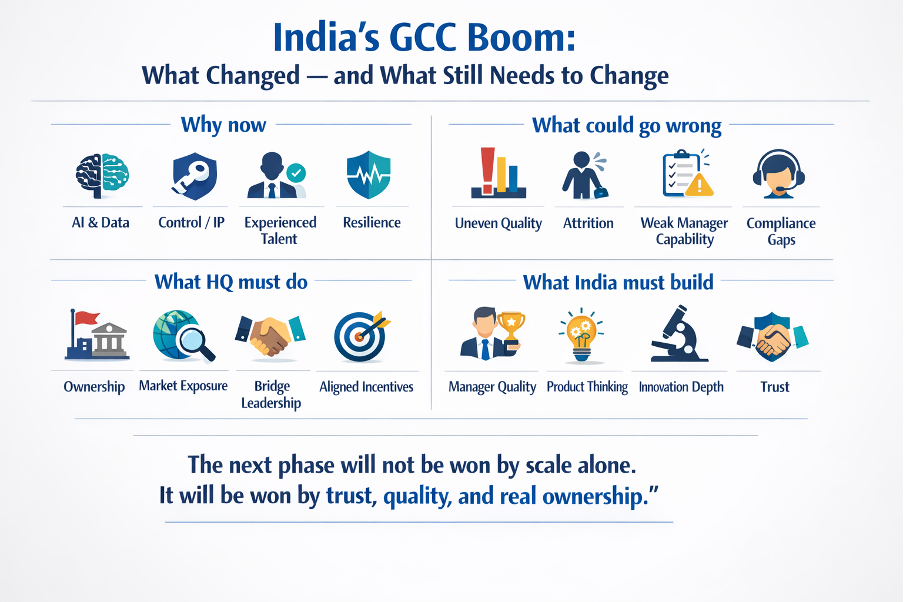
My take
So here is my take.
India’s GCC boom is not happening because the old captive model suddenly became fashionable again. It is happening because ownership, capability, resilience, and speed matter more now than they did earlier.
And yes, I do think it will sustain — but only for companies that treat India as a place to build capability, leadership, and business value, not just a place to send work.
The next phase will not be won by scale alone. It will be won by trust, quality, and real ownership.